
A building is not smart. The technology must be.

A conversation with Koen Verschuere, founder and CEO of Fixsus
Anyone meeting Koen for an interview should wear good shoes.
The conversation begins upstairs, in the Fixsus meeting room in Evergem. Coffee and tea are on the table, along with a PLC module. A remnant from the previous meeting, it seems. Koen slides it aside without saying a word. I haven’t even asked my first question before he is standing up again.
“Come, I will show you what we do first.” He is already gone, down the stairs, three steps at a time.
Developed in-house
At the bottom of the stairs, we enter the lab. On the workbenches lie prototypes and modules for residential care centers, government buildings, banks, and offices, and test setups stand along the wall. Koen introduces me to everyone and picks up a module along the way to explain something. You can tell he prefers being here.
Everything here belongs to Fixsus itself: in addition to the software, the team also develops touch panels, room controllers, and sensors. Those who manage a building thus have a single point of contact, from the panel on the wall to the software behind it.
Just as suddenly as he left: “Okay, back upstairs.” Again, three steps at a time.
Bricks and concrete
Once back at the table, Koen immediately goes on the attack against one of the most popular terms in his sector.
“Everyone is talking about smart buildings,” he says. “But a building cannot be smart. That is brick and concrete. The technology must be smart, and it must work together as well.” In the world of building automation, that was not a given for a long time.
What did that look like when you started?
“When I started in this sector, every system had its own controller,” he says. “The HVAC had its control, the lighting another, the sun protection yet another. They worked alongside each other, not together.”
What a factory can handle, a building can too
He found the solution not in the construction sector, but in industry. “In the process industry, I saw much heavier and more complex processes running on PLC control. Sometimes a single PLC controls an entire production line there. So I found it much more logical to use that in buildings as well.”
He had the idea in 2008, and in 2009 he founded Fixsus. The market was then in the hands of a few large brands, each with its own closed system. Koen chose the industrial PLC from Beckhoff: one central controller to which all technologies connect.
What does that change concretely in a building?
“Because of that, the systems truly talk to each other,” he says. “The ventilation knows if someone is in the room, the sun protection takes the cooling into account, and you avoid peaks in your consumption.”
Wasn’t that a risk, going against the big brands?
“Of course that was a risk,” he says. “But if we had just done what everyone else was already doing, we could have closed after a year. Among all those big names, being different was our only chance.”
No locks on the door
In addition to the industrial PLC, he holds onto something else: openness. TIBA3, the building management system on which all Fixsus installations run, is built on this. Those who work with it are not tied to a single supplier.
“We work with open standards such as BACnet, Modbus, and DALI-2. Heat pumps, charging stations, batteries, new HVAC: we can control almost any technology in TIBA3.”
Never a system that causes trouble?
He smiles. “Occasionally you come across a system that is so closed that no one can access it, including us. But those are truly exceptions. That is not boasting; that is simply how an open system works.”

“If we had just done what everyone else was already doing, we could have closed after a year.”
Koen Verschuere, founder and CEO of Fixsus
Renovating without demolition
Because of that openness, there are also many requests for retrofits: existing buildings where the technology has become a patchwork over the years, each with its own language.
What does such a building look like when you arrive?
“In many buildings, there are three or four generations of technology,” says Koen. “Every installer added something in their time, with its own control and its own protocol.”
Does all of that have to be replaced then?
“Usually not. Often we can keep the existing cabling. Nothing needs to be broken open, and the building remains operational while we are working.” In a residential care center, that means: the residents simply stay in their rooms.
The black box
What annoys Koen most in his sector: a building that no one understands after completion. “An owner is stuck with their building for twenty, thirty years,” he says. “They need to know what is in it. Otherwise, it becomes a black box, and the first technician who needs to adjust something is left guessing.”
That is why Fixsus sits directly at the table with the owner in many projects, not just with the installer. For the same reason, the architecture remains deliberately simple.
In twenty-five years
Where do all those choices come from?
Koen thinks for a moment. “A building easily stands for fifty years. Yet automation is often designed as if it will be replaced after eight years. That is not right. I always ask myself the same question: can someone still understand and adjust this in twenty-five years?”
What does that mean in practice?
“A technician must be able to maintain our system with a voltmeter and a screwdriver,” he says.
That question about twenty-five years is behind the entire structure of TIBA3. It also explains why simplicity always comes first and why maintenance carries as much weight as the installation.
“A technician must be able to maintain our system with a voltmeter and a screwdriver.”
People first
Before we wrap up, Koen wants to share something else, something he perhaps finds most important. “Fixsus stands or falls with its people,” he says. “We work hard, but we also laugh a lot. That is no coincidence; we choose that. Building a company makes no sense if the people don’t enjoy working there.”
He monitors that everyone feels good himself, even now that the team numbers more than thirty people. You can hear in his tone that this is non-negotiable. Customers notice this too: many new assignments come through word of mouth, from people who are satisfied and pass it on.
What do customers value most?
“When a customer needs you, you are there. That is all.”
When the lab goes quiet
What do you enjoy working on most today?
“The team keeps the company running, and I am happy with how they do that,” he says. “I still really enjoy explaining to new customers how we look at buildings. But secretly, I am at the design table in the evenings and at night. That is where I work on new prototypes for hardware, or look for a solution to a technical problem that won’t let me go.”
He admits with a grin that he sometimes gets a bit too little sleep because of it. He doesn’t drink coffee; he swears by tea. He accepts that it usually gets cold before he gets to it.
The map

At the end, Koen walks to the map of Belgium on the wall. It is full of pins: residential care centers, offices, government buildings, banks. By now, there are more than 500.
“Every pin is a building where our system is running,” he says. Then he is silent for a moment, and for Koen, that is a long time.
He looks at the pins for a moment longer and then walks to the stairs, with the PLC module under his arm. Halfway there, he turns around. “Did you actually have any more questions?” On the table stands his cup of tea, cold and untouched.
Dit delen:

Fixsus team
Gebouwbeheersystemen, Fixsus
Gerelateerd nieuws
-
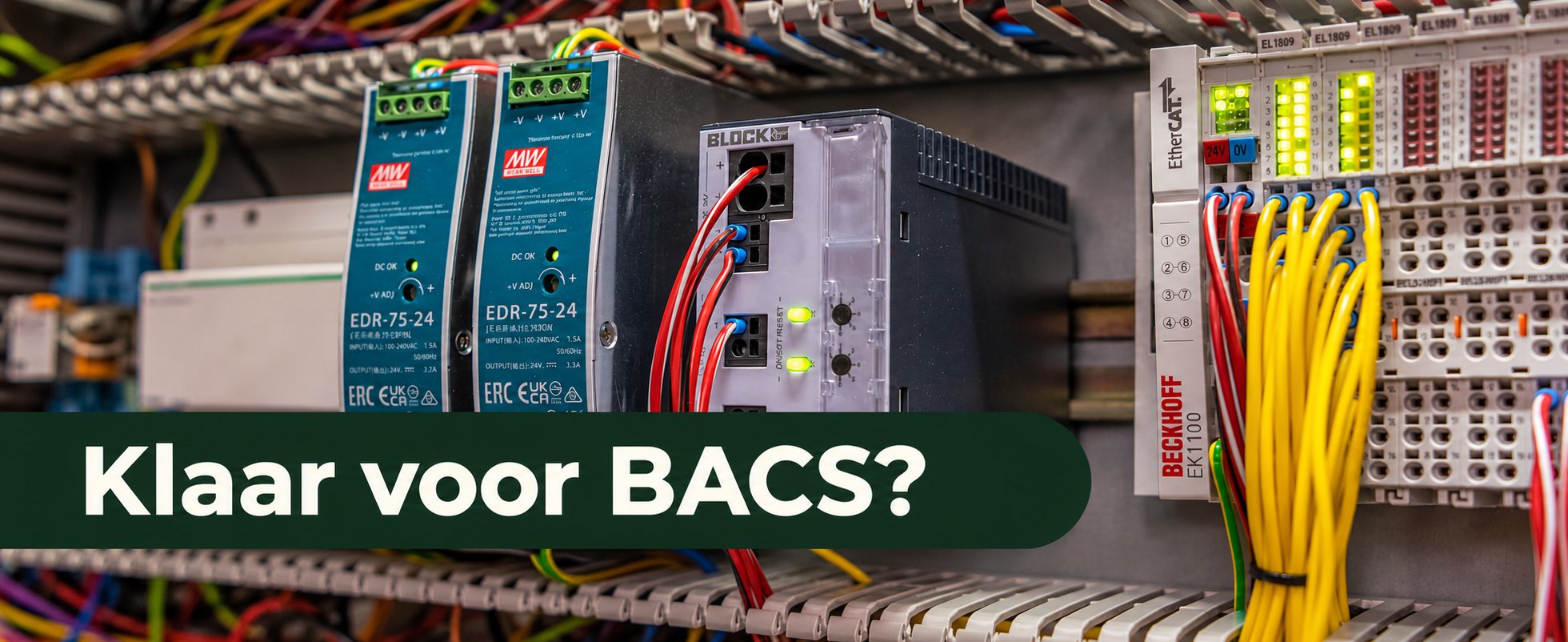
BACS-compliant without replacing everything
Your building management system is due for replacement and BACS is just around the corner. Often, renewing the control cabinet is sufficient. Sensors, valves, and cabling simply remain in place.
-

Retrofitting in healthcare: control over your building without replacing everything
Healthcare technology that fails to communicate? A retrofit brings everything together without the need for full replacement.
-

The weather remains unchanged. And your building is sweating along with it.
On repelling heat, cooling, measuring, and controlling.