
Eight boilers, three CHPs, and a trimmed beard

Visiting WZC Maria Rustoord in Ingelmunster
It is Tuesday afternoon as I pull into the car park of the Maria Rustoord residential care center in Ingelmunster. Maxime, our project manager on this site, is already waiting for me at the entrance. He has coffee with him. That is certainly a good start to the afternoon.
“Come on,” he says, “we’ll start in boiler room 4 in the basement.”
Now, I must be honest: when someone invites you on a Tuesday afternoon to go look at boiler rooms, it doesn’t exactly sound like the highlight of your week. But at Fixsus, I have learned better by now. Behind every project, there is a story. And the story of Maria Rustoord is a unique one.
Five buildings, zero overview
As we walk through the corridors, the context is explained to me. Maria Rustoord is not a building that was ever designed all at once on an architect’s table. It is a healthcare site that has grown over the years, building by building, wing by wing. Five separate buildings were merged step by step into a single campus. Today, that campus offers a homely, warm environment to 180 elderly people in need of care, spread across seven residential units.
However, every expansion brought new technologies with it. Four boiler rooms, two sub-boiler rooms, eight boilers, and three combined heat and power (CHP) units, scattered across the entire site. The distances between the buildings were too great to manage everything from a single central point, so local solutions emerged. “Stopgaps”, they are called. Control systems that did not communicate with each other. Systems that were never synchronized.
In practice, as I hear while we step into a technical room, it came down to this: everything was either on, or everything was off. There was nothing in between.
Six men in six boiler rooms
What immediately strikes me as we make our rounds: Fixsus colleagues are at work all over the building. About six of them, spread across the various boiler rooms and technical spaces. Some rooms are so cramped that you cannot even stand upright. In one spot, it was literally impossible to place a step ladder.
In one of those basement rooms, a site radio is playing. The genre coming out of it is—how shall I put this diplomatically—not quite what the residents one floor up would have on their wish list. But then again, the residents’ favorite listening music probably wouldn’t cause a productivity peak for our technicians either.
In another boiler room, a colleague gestures to me. “Tom! Come and have a look!” He had rebuilt an entire cabinet that day and wanted to show me the result. Everything neat. Everything labeled. He stood there like an artist who had just finished his canvas.
The story of the air handling unit
Something else remarkable. During the first phase of the project, the team came across an air handling unit that had been labeled as “defective” for years. It was scheduled to be removed.
But when it was integrated into the Fixsus platform, the installation itself turned out to be perfectly fine. The problem lay in the communication with the old building management system. Not in the machine.
Without replacement. Without extra investment. The air handling unit was simply running again.
“To us, this is exactly what retrofit is all about,” says a technician. “Not just replacing what is there, but first understanding what exists. So, we actually saved that air handling unit from the scrap heap.”

Patrick
After the tour, I am introduced to Patrick, one of the three permanent technicians at Maria Rustoord. Down-to-earth, experienced, and not someone who is easily impressed.
I ask him what has changed for him since Fixsus arrived. He thinks for a moment. And then he says something I will remember for a long time: “Well, these are finally guys who know what they’re talking about!”
No long explanation. Just that one sentence, straight to the point, with the relief of someone who has fought for years with tools that weren’t up to the task.
Patrick tells me how it used to be. If there was no hot water, the search began. Boiler room by boiler room, manually, by feel. Guesswork, he calls it himself. Not because he and his colleagues weren’t capable, but because the tools simply weren’t there.
Today, they work with one central platform where they can monitor everything. See faults. Understand installations. Make adjustments themselves where necessary. The difference, he says, was felt immediately.
You can tell when frustration has been replaced by job satisfaction.
The Director
To my pleasant surprise, Managing Director Geert Dujardin has also made time for me. A man who speaks plainly, without beating around the bush.
He tells me about the years before. The various companies that had come through the door via tenders. A different party every time, a different approach every time. No common thread. No one truly looked at the whole picture. In some rooms, heating and cooling were even running simultaneously because no one had synchronized them. The moment the costs became truly too high, the decision was made to remove all the old controls.
 “Everything that was there failed to communicate and was outdated. The better everything is coordinated, the more profitably we operate. It’s as simple as that.”
Geert Dujardin, Director
How did he end up with Fixsus? “Through a friend of mine. He was the operational director at a large residential care center and had worked with Fixsus before. That gave me the confidence.”
No advertisement. No sales pitch. Just a colleague calling and saying: this works.
And then the director says something that sticks with me, because it has nothing to do with technology. “We also find the service very important. We can always call Fixsus. We have someone on hand we can ask for explanations.”
Always reachable. Always follow-up. No endless escalations, tickets, or queues. Just someone who knows the context, thinks along, and picks up when needed. It sounds obvious, but anyone who has ever worked with a large supplier knows it rarely is.
When asked if he would recommend Fixsus to fellow directors: “Absolutely. Without a doubt.”
Coffee in the visitor cafeteria
After the tour and the conversations, we gather in the visitor cafeteria near the residents. Six Fixsus technicians, Maxime, and myself. And, oh yes, a photographer. Because we had invited one to take images for our new website.
That caused some initial unrest within the team. Some colleagues were a little bit nervous. One had even specially trimmed his beard for the occasion. His new look earned him a healthy dose of jokes from his colleagues for the rest of the day. But when I look at this setting, I see something that is hard to put into words. I see a team having fun. Colleagues who are proud of what they do. Who help, tease, and encourage each other, often in the same sentence. That grows naturally when the right people work together on the right projects.
What stays with me most
Patrick, finally working with a system that helps him instead of working against him. The team, visibly enjoying showing how the platform brings everything together. And Director Dujardin, who tells me with a broad smile: “We are very happy that we made this decision. This is the beginning of a whole series of investments for the future.”
Back to the car
I say my goodbyes, shake Patrick’s hand, and thank the director. The colleague with the trimmed beard waves me off from the car park. He looks better. I have to give him that.
As I walk to my car, I reflect on the fact that I came this afternoon with slight reluctance to look at boiler rooms in a care home. And I leave with a stain on my shirt, a full memory card, and the feeling that this was a really great day.
I get into the car. The heater kicks in. It works.
I smile. And I suspect the colleague with the beard is doing the same right now.

Dit delen:

Fixsus team
Gebouwbeheersystemen, Fixsus
Gerelateerd nieuws
-
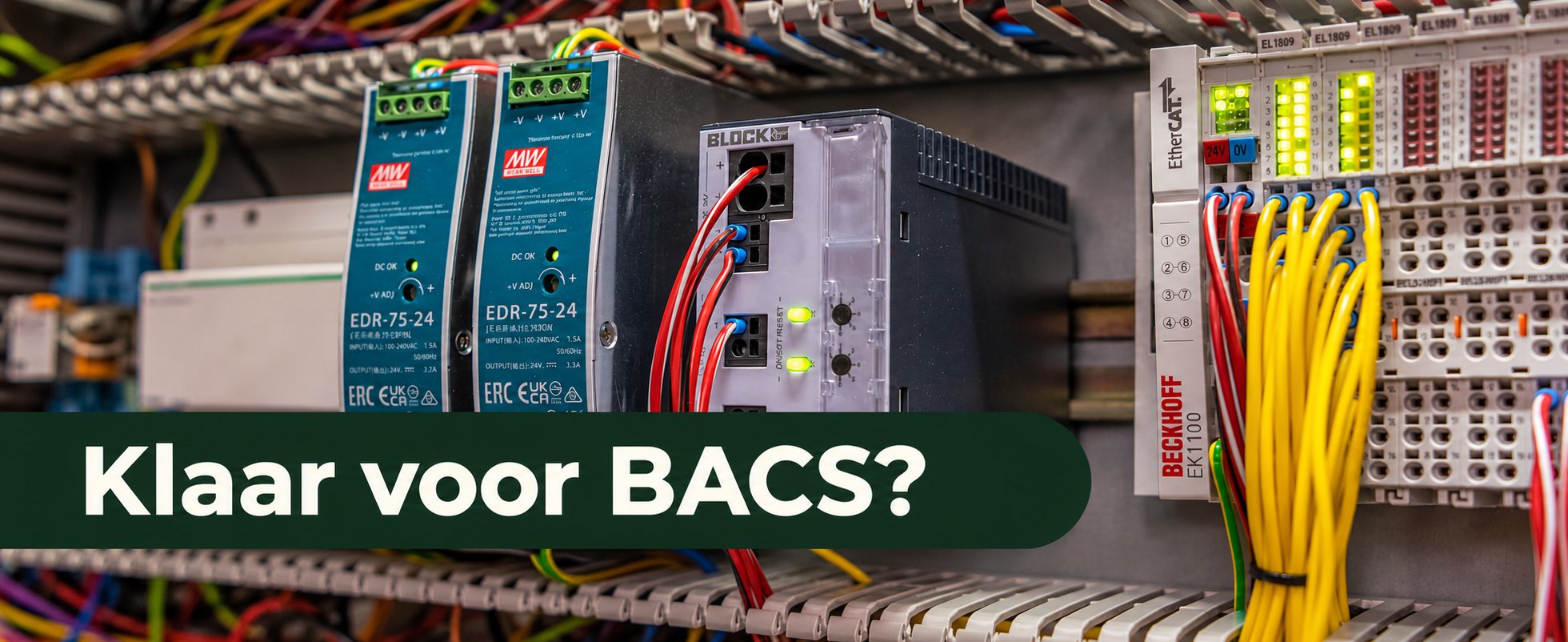
BACS-compliant without replacing everything
Your building management system is due for replacement and BACS is just around the corner. Often, renewing the control cabinet is sufficient. Sensors, valves, and cabling simply remain in place.
-

A building is not smart. The technology must be.
Koen Verschuere on open systems, retrofits without demolition work, and buildings that will still be understandable in twenty-five years.
-

Retrofitting in healthcare: control over your building without replacing everything
Healthcare technology that fails to communicate? A retrofit brings everything together without the need for full replacement.